Fractured-porous and karstified aquifers at EGU 2026
Convening field, laboratory, analytical, and numerical work on multiscale flow and transport in fractured and karst systems.
Connecting flow through pores, fractures, and conduits to aquifer and catchment response.
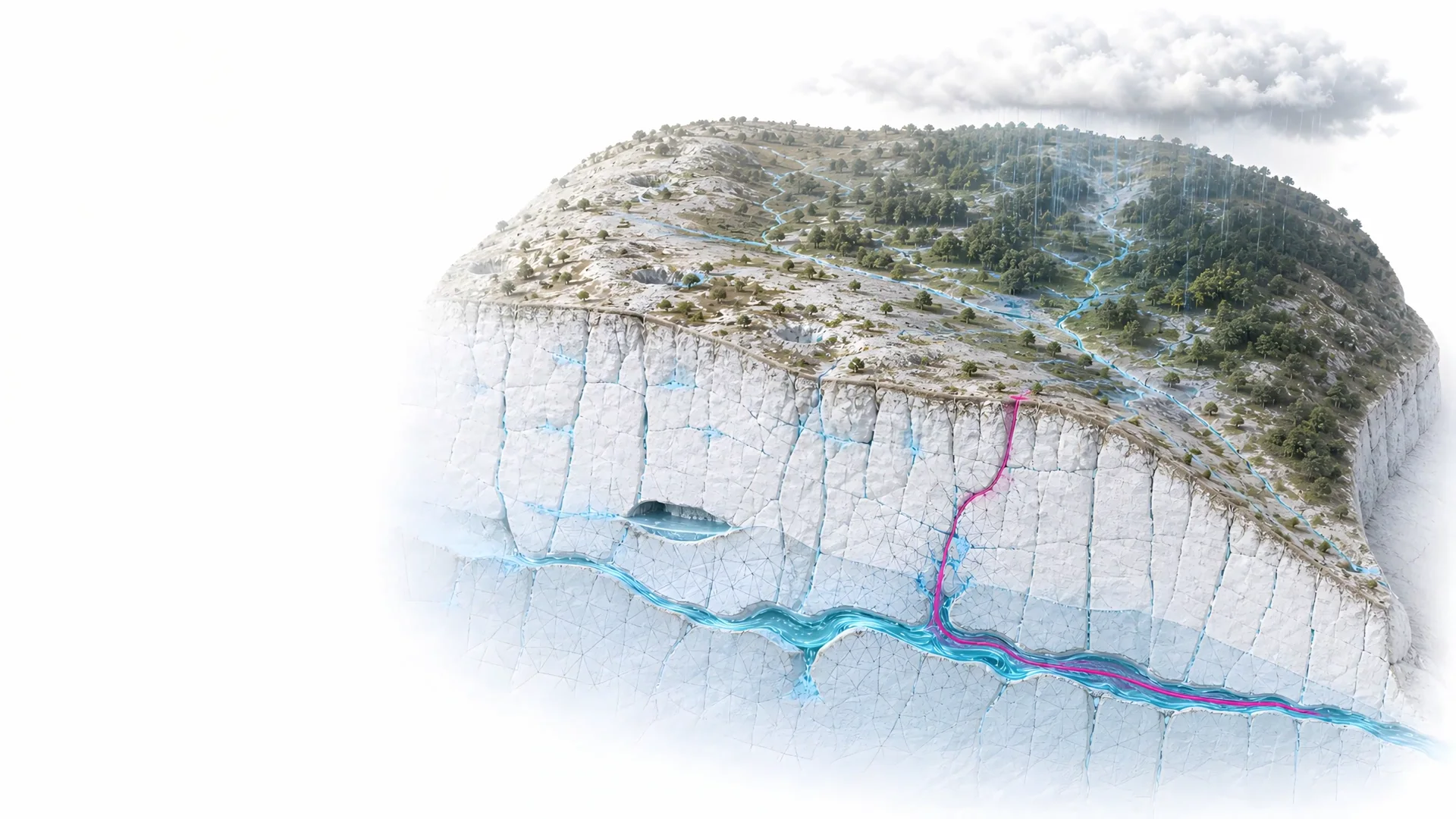
01 · Surface–subsurface coupling
Recharge is organized by soil, rock structure, wetting conditions, and the pathways that activate during an event.
02 · Deep vadose pathways
Local flow physics determine partitioning, travel times, matrix exchange, and the activation of connected fracture networks.
03 · Karst groundwater & conduit networks
Numerical network and aquifer-scale models connect recharge forcing with transient flow, transport, storage, and observable spring or groundwater response.
One multiscale question
Why it matters
In soils and fractured-porous aquifers, including karst systems, groundwater response depends on how flow pathways connect and when they activate.
Experiments resolve local processes, geology constrains the relevant structure, and numerical models test the consequences from aquifer to catchment scale.
Convening field, laboratory, analytical, and numerical work on multiscale flow and transport in fractured and karst systems.
Four days of exchange across groundwater research and practice, with 19 specialist sessions in Leipzig.
A dual-domain model combining preferential film-flow dynamics with compartment-specific sensitivity analysis.
An open-source simulator for transient flow and transport in complex karst conduit networks.
Defended in 2024, bringing together multiscale work on fractured-porous media and karst systems.