Integrated research programme

From local flow pathways to groundwater response.

Experiments, field evidence, and process-based numerical models connect preferential flow in fractured and karst systems with recharge, aquifers, and catchments.

01 · Resolve

Preferential flow in fractures and porous media.

Droplets, rivulets, and films create rapid pathways within otherwise diffuse and slowly responding flow fields.

At intersections, flow morphology controls bypass, temporary storage, and matrix uptake; inflow and surface state determine the balance.

Network-scale pathways Preferential fracture flow with adjacent matrix wetting
Animated two-dimensional side section of a large constant-volume drop moving downward along a rough vertical fracture wall. Straight local tangent pairs at the pinned points indicate advancing and receding contact angles as the lower contact advances before the upper contact follows.
Contact-line dynamics Roughness pinning · angle hysteresis · stepwise advance
Three vertical limestone fracture surfaces compare descending droplets, a narrow rivulet, and a broad film. A pearly-white pulse traces and briefly illuminates the progressively larger wetted contact footprints.
  1. Droplets
  2. Rivulet
  3. Film
Flow morphology Wetted footprint: localized · linear · areal
Animated asymmetric fracture intersection comparing rapid droplet bypass with a descending rivulet that pauses at the junction, partitions into lateral storage and matrix wetting, and produces delayed vertical release.
Partitioning + matrix exchange Flow-dependent bypass · lateral storage · delayed release
02 · Represent & connect

Retaining the preferential-flow dynamics that control larger-scale response.

Fractures, matrix, and conduits form one connected system, but need not be represented with equal detail.

Two decisions matter: what process information to retain and where to represent it explicitly.
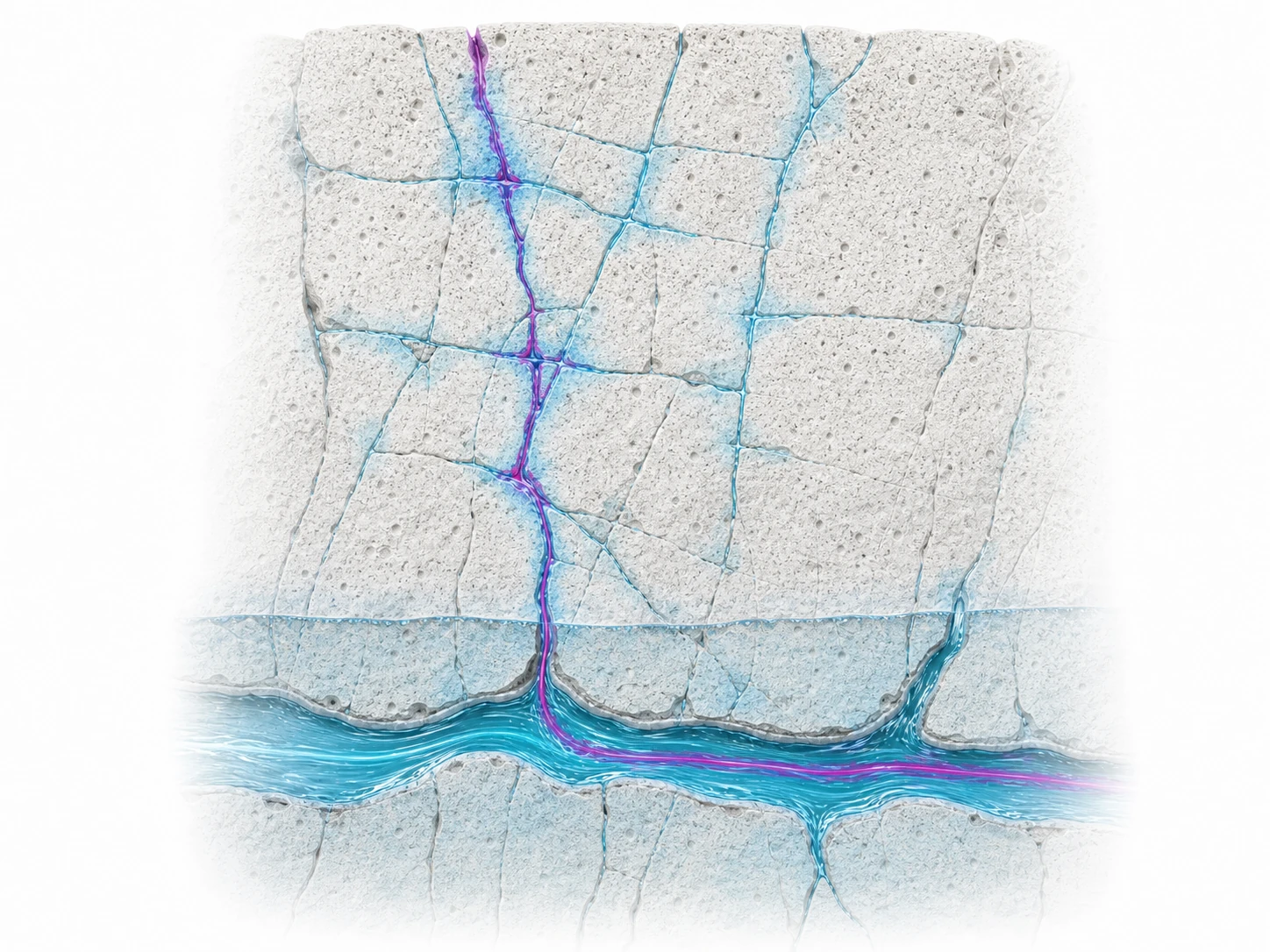
Conceptual limestone section in which a predominantly vertical magenta preferential path descends through a fractured porous vadose zone, reaches a water-filled conduit, and then follows predominantly horizontal phreatic flow to the right; cyan wetting indicates exchange with adjacent fractures and matrix. Preferential
flow
Diffuse
flow
Phreatic conduit flow
Connected physical system Fracture recharge · matrix exchange · conduit routing
  • Preferential-flow dynamics
  • Pathway–matrix exchange
  • Vadose–phreatic coupling
Process-representation step

Choose what the model retains.

Retain only the dynamics needed at the next scale.

Three model choices

01Response mapping
Animated response-kernel mapping A response kernel repeatedly scans an input signal while the delayed and broadened output signal is drawn below it. response kernel input output qout(t) = ∫₀ᵗ h(t−τ) qin(τ) dτ
Retains input–output behaviour
02Preferential-flow state
Animated fracture-film model showing a thin water film and its repeating velocity-profile development beside a fracture surface, with the governing film-flow equation.
Retains film dynamics
03Coupled-domain exchange
Animated model showing separate fracture-pathway and matrix-storage states linked by repeating two-way exchange, with the governing storage-memory and outflow equations.
Retains separate states and memory
04Transfer to groundwater model
Combined or partitioned recharge
Animated combined recharge or separate pathway and matrix recharge signals repeatedly enter a phreatic groundwater model.
Spatial-architecture step

Choose where heterogeneity remains explicit.

Move from bulk response to route-specific flow. More detail preserves geometry and exchange structure.

One spectrum · five spatial architectures

Visual comparison of five spatial model architectures from an effective continuum to an explicit pathway network.
01 / 05 Effective continuum One bulk-flow field; pathway and matrix effects are averaged.
03 · Apply & integrate

From processes to groundwater decisions.

Numerical models integrate recharge, storage, connectivity, and observations for applications such as water availability and vulnerability.

System

Input & infiltration
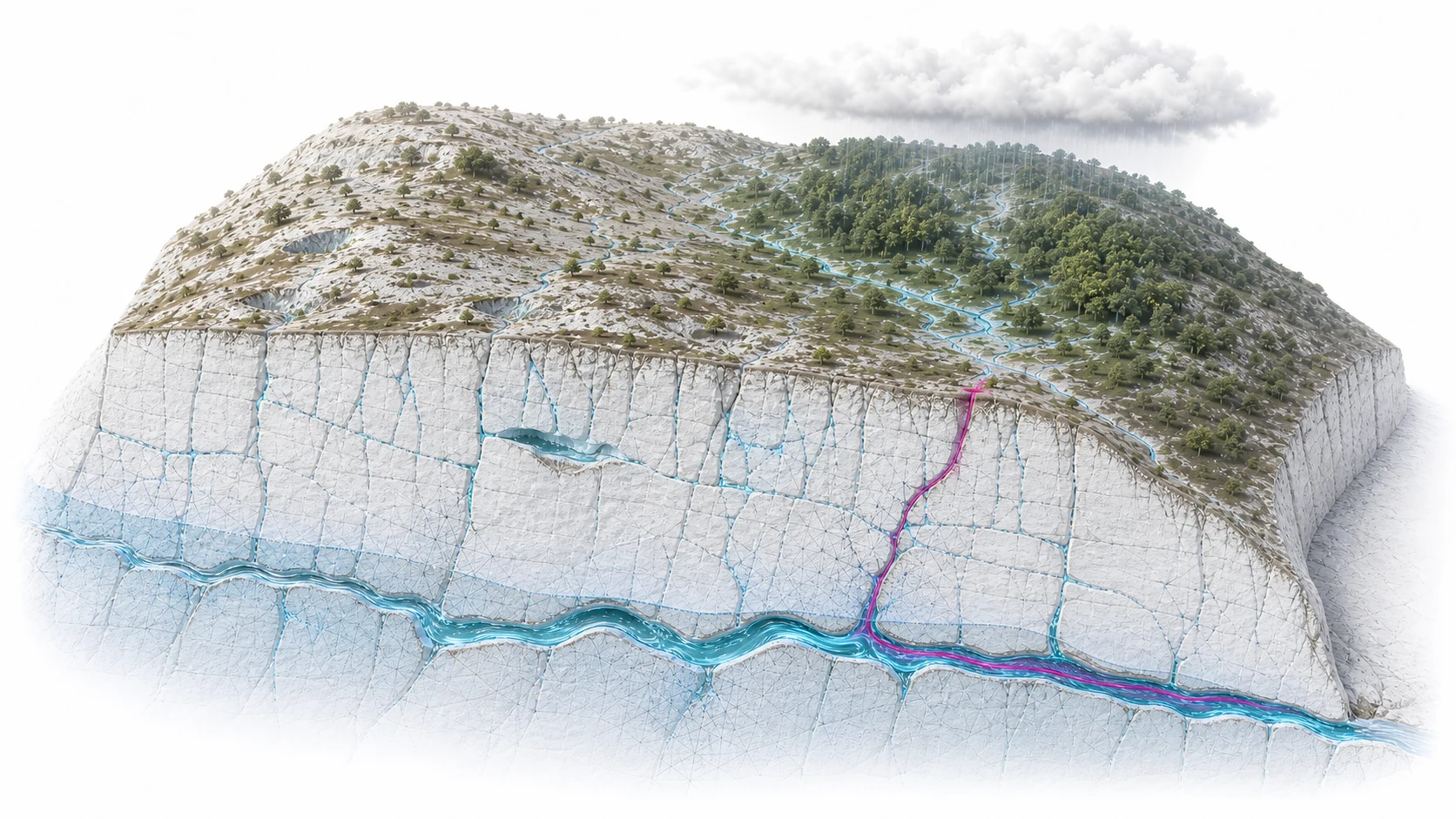
Centered conceptual three-quarter cutaway of a complete karst catchment, showing surface forcing, a deep fractured vadose zone, pale groundwater storage, a water-filled conduit system, and one continuous magenta preferential pathway from the surface toward the outlet. Processes, observations, groundwater decisions, and spatial simulation Five interactive views follow rainfall through infiltration, storage, fast pathways, spring signals, water-availability scenarios, and spatial groundwater vulnerability. Storage and coupling compares a broad, slowly descending diffuse matrix front with three focused pathways that begin in focused surface cells. Two slimmer left pathways suggest fracture-network transfer, while the wider right pathway represents stronger preferential flow. The diffuse front continues behind the groundwater-recharge inset to signal catchment-wide infiltration. The inset curves appear and fade when the corresponding focused pathways or diffuse front arrive near the static conduit system. Signals and inference aligns relative discharge, temperature, and solute responses to one observed event. A looping view then uses those observations to test twelve coherent predictions for a new event: temperature rejects five futures with incompatible timing, chemistry rejects three with incompatible mixing and storage, and four credible futures remain around a highlighted prediction and density ribbon. The vulnerability view combines surface cover with diffuse or focused infiltration, then compares relative arrival at the groundwater boundary. A sixth openKARST view resolves recharge, reservoirs, conduit hydraulics, and spring discharge spatially. INPUT + INFILTRATION RAINFALL INPUT RUNOFF TO SINK FOCUSED INFILTRATION STORAGE + COUPLING EXCHANGE DIFFUSE MATRIX RECHARGE FOCUSED PATHWAYS PHREATIC CONDUIT SPRING GROUNDWATER RECHARGE FOCUSED DIFFUSE RECHARGE RELATIVE TIME → EARLY STORAGE LATE RELEASE WATER AVAILABILITY MATRIX STORAGE BUFFER PHREATIC CONDUIT → SPRING SLOW RELEASE SUSTAINS FLOW SPRING SPRING-FLOW AVAILABILITY total = baseflow + rapid events matrix-supported baseflow A · ADAPTIVE-USE PROJECTION B · DRIER / HIGHER-USE PROJECTION DISCHARGE PROJECTION TIME AVAILABLE BUFFER DEFICIT 02 EVENT RECHARGE + MODEL RESOLUTION INTENSE, FOCUSED EVENT RESPONSE AFTER AN INTENSE EVENT log response single-continuum smoothing fast intermediate slow tail time FAST PATH + DISTRIBUTED TAILS 03 MANAGEMENT SCENARIOS BOREHOLE HEAD critical level PROJECTED SPRING DISCHARGE adaptive baseline stress climate pattern × abstraction → head and discharge trajectories 01 SOURCE EXPOSURE THIN SOIL / BARE KARST DRY VALLEY / SINK THICKER SOIL COVER COVER + FOCUSED INFILTRATION → EXPOSURE BARE / THIN SOIL FOREST / SOIL 03 PROTECTION DECISIONS CONTROL RAPID-RECHARGE SOURCES VERIFY CONNECTED PATH EARLY WARNING AT SPRING source control · monitoring · response time OBSERVATIONS CONSTRAIN PREDICTIONS OBSERVED Q · T · C CONSTRAINED Q RESPONSES Q discharge T temperature C solute EVENT TIME → Q Q + T Q + T + C Q + T + C T C PREDICTED RESPONSE FORECAST TIME →

Rainfall divides into diffuse infiltration, runoff, and focused recharge.

Programme and leadership

A connected research programme across scales.

The three chapters also trace the development from process-resolving fractured-flow research to PI-led work on scale transition, karst recharge, and system-scale modelling.

  • 2016–2021 · DFG · PIMultiscale SPHCross-scale flow and transport in unsaturated fractured-porous media
  • 2018–2024 · DFG · PIiKarstIntegrated spring-signal interpretation for multi-compartment karst systems
  • 2019–2024 · DFG · PIPreferential flow dynamicsFracture-network topology and dual-domain model parameterization
  • 2023– · ERC · Lead developerKARST / openKARSTTransient flow and transport in complex karst conduit networks

Together, these projects preserve the preferential-flow dynamics needed at each scale while using the level of physical detail appropriate to the groundwater question.